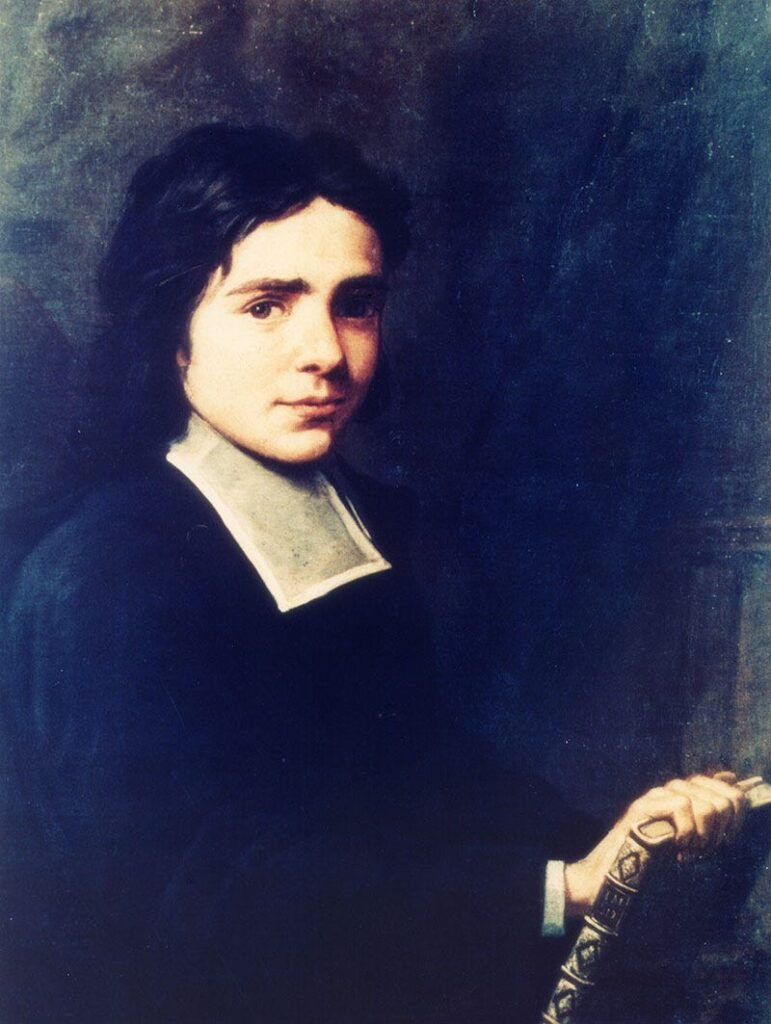
Father Claude-François Poullart des Places, Founder of the Congregation of the Holy Spirit — anniversary 2 October 2026.
Living in an Intercultural Community in the Light of “Choix d’un État de Vie” — a nine-day Spiritan novena from 23 September to 1 October, prepared by Frs. Jean-Marie Ombe Essomba, Hervé Buru, and Raymond Jung, on the theme “Behold, I am doing something new” (Is 43:19).
This novena invites us to revisit selected passages from Claude-François Poullart des Places’ Choix d’un État de Vie as a spiritual pathway for life in an intercultural community. Living in an intercultural community is far more than sharing a house with people of different origins — it is, above all, an inner journey: learning to recognize one’s own limits and attachments, moving beyond self-centredness, purifying one’s motivations, and welcoming others without reducing them to our expectations. Each day below offers a passage from Choice of a State of Life, preceded by a text from Scripture, as material for meditation.
Jump to a day: Day 1 · Day 2 · Day 3 · Day 4 · Day 5 · Day 6 · Day 7 · Day 8 · Day 9
23 September — Day 1: Radical Self-Emptying
Theme: inner freedom opens the door to hospitality
On this first day of the novena, we are invited to enter the journey through an inner movement of self-emptying. Life in an intercultural community—just like following Jesus—begins with a fundamental renunciation: ceasing to make ourselves, our culture, or our habits the ultimate point of reference. Today, as we meditate, let us ask for the grace of true inner freedom, the freedom that makes us available to God and open to the brothers and sisters with whom we share our lives. May the Holy Spirit teach us to welcome what unsettles and challenges us—not with fear or withdrawal, but as a path of growth, transformation, and communion.
Word of God — Luke 9:23–24
Then he said to them all: “Whoever wants to be my disciple must deny themselves and take up their cross daily and follow me. For whoever wants to save their life will lose it, but whoever loses their life for me will save it.”
Poullart des Places
“O my God, who leads those who truly entrust themselves to you to the heavenly Jerusalem, I turn to your divine Providence; I abandon myself entirely to it; I renounce my inclinations, my desires and my own will in order to follow yours blindly. Deign to make known to me what you wish me to do, so that, by living here on earth the life you have destined for me, I may serve you, during my pilgrimage, in a state in which I am pleasing to you…”
Intercultural relevance: Self-effacement is the indispensable foundation for any genuine encounter with the other and for any departure from ethnocentrism. After his retreat of 1701, Claude Poullart des Places no longer lived turned in on himself or seeking the approval of others. He desired only to do God’s will, and in gratitude to his “Liberator,” he rejoiced in being able to serve Him in the poor, “who are His members.” He did not limit himself to acting on their behalf; he chose to live among them, becoming poor with the poor.
Reflection
To renounce one’s inclinations and one’s own will is not a negation of the self, but an act of faith rooted in trust in divine Providence. In the Ignatian tradition of holy indifference, this renunciation leads to authentic freedom by shifting the self away from the centre of meaning and control. Such an attitude opens a space for encounter—both human and divine—where identity is received rather than constructed in isolation. This movement of decentering becomes a fundamental principle of true intercultural encounter: relinquishing control over our interpretative frameworks allows us to welcome different worldviews and to be transformed by them. The “choice of a state of life” thus appears as a stepping outside of oneself, an inner exodus in which identity is discovered in relationship and in the acceptance of otherness.
Prayer
Lord God, you who call us to follow you, teach us to renounce all that imprisons us within ourselves. Free us from the need to be right, from making our culture or our habits the measure of all things. Grant us a heart that is free and open, ready to be moved by your Word and by the presence of our brothers and sisters. May our community become a place where each one learns to step aside to make room for your Spirit. Amen.
24 September — Day 2: A Shared Vocation Beyond Our Differences
Theme: a universal purpose
Today we turn our gaze to what unites us more deeply than anything that distinguishes us. Despite the diversity of our origins, languages, and sensitivities, we share the same fundamental vocation: to love and serve God. This common calling is the foundation of every authentic community. When we rediscover it, our differences take their rightful place—not as threats, but as gifts placed at the service of a shared mission. Living in an intercultural community becomes possible only when we remember that our unity precedes our diversity, and that our diversity enriches our unity.
Word of God — Ephesians 4:2–7
Be completely humble and gentle; be patient, bearing with one another in love. Make every effort to keep the unity of the Spirit through the bond of peace. There is one body and one Spirit, just as you were called to one hope when you were called; one Lord, one faith, one baptism; one God and Father of all, who is over all and through all and in all. But to each one of us grace has been given as Christ apportioned it.
Poullart des Places — A Common Purpose Beyond Differences
“God created me only to love Him, only to serve Him, and then to enjoy the bliss promised to righteous souls. That is my sole concern; that is the goal towards which I must direct all my actions. I am a fool if I do not work in accordance with this end, since I must have no other. Whatever happens from now on, I must therefore remember that every moment I do not spend living well is a moment lost, and for which I will have to give an account to God.”
Intercultural relevance: affirmation of a universal horizon that relativizes differences in status, culture or circumstances. The young Claude Poullart des Places played the role of ‘glory’ in the theatre; his biographer says that “his passion was for glory and for reputation”. But during his retreat, “he joyfully renounced the world in which he saw nothing but vanity; he attached himself to his God and to all that might please him”. After this retreat, he had “a particular affection for the most obscure works, for the abandoned works.”
Reflection — A Universal Purpose: the Theological Foundation of Equality in Diversity
We all share the same purpose: to love and serve God. This gives every human life a fundamental value and meaning intended by God. No state of life, no culture or social condition can claim to represent this vocation on its own. This allows us to recognise differences without setting them against one another. This conviction is rooted in faith in creation: all human beings are created for God, and not for any particular social or cultural system. This shared orientation forms the basis for a respectful way of looking at others: they are never a means, but a person called, like me, to respond to God. From an intercultural perspective, this prevents us from elevating our own culture or our way of living the faith to the status of an absolute model. The diversity of ways of life then appears not as an obstacle, but as a source of richness, a plurality of paths leading towards the same horizon, opening up to a communion that does not erase differences but welcomes them.
Prayer
Lord Jesus, you call us all to the same vocation, despite the diversity of our origins and our journeys. Remind us each day that we are first and foremost united in you. When differences weary us or divide us, bring our hearts back to what matters most: to love, to serve and to seek your glory. Make our community a sign of unity, at the service of your mission in the world. Amen.
25 September — Day 3: Re-examining Our Cultures in the Light of the Gospel
Theme: detachment from human perspectives
This third day invites us to take a critical and faith-filled look at our own cultures. Each culture carries genuine riches, but also limitations, conditioning, and at times even idols. Intercultural life becomes fruitful when we allow the Word of God to question our ways of thinking, deciding, and living together. Let us ask for the grace of discernment, so that we may recognize what comes from God and what stems solely from our human logic.
Word of God — Romans 12:1–2
Therefore, I urge you, brothers and sisters, in view of God’s mercy, to offer your bodies as a living sacrifice, holy and pleasing to God—this is your true and proper worship. Do not conform to the pattern of this world, but be transformed by the renewing of your mind. Then you will be able to test and approve what God’s will is—his good, pleasing and perfect will.
Poullart des Places
“Where I find your interests, I shall remain to safeguard them, but where I find only those of the world, I shall flee as from a serpent. If I am fortunate enough, my God, [to find the state] in which your divine Providence intends me to serve you, you will grant me the graces I need to keep the matter of my salvation ever present in my mind, and to forget all other matters of life. I detach myself, my God, from all the human perspectives I have held hitherto in every choice of life I have considered.”
Intercultural relevance: taking a critical step back from dominant social norms before making any choice. In 1702, Claude Poullart des Places confessed that “participation in the Body of Jesus” made him “despise the world and its ways,” that he cared little “about winning its esteem,” and even that he sometimes sought to “displeasing it by going against its customs.” For his tonsure, he chose “the habit and simplicity of the most reformed clergymen,” without worrying “about what might be said of it.”
Reflection — Detaching Oneself from ‘Human Views’: Critical Discernment of Cultures
Detaching oneself from “human views” does not mean despising the world, but exercising a spiritual critique of the logic of power, glory, and success. Theologically, this is the work of discernment of spirits: distinguishing what belongs to God from what belongs to the world in the Johannine sense. Such an attitude requires the capacity to question the implicit norms of one’s social and cultural environment. From an intercultural perspective, this discernment is essential: every culture contains values, but also idols. The believer is therefore called to a critical engagement with their own culture before evaluating that of others. In this light, the Choice of a State of Life becomes a prophetic act, capable of resisting dominant social and cultural determinisms. It invites us to let the Gospel purify our perspectives so that our identity may be shaped not by cultural conditioning, but by the call of God.
Prayer
Holy Spirit, you who enlighten hearts, teach us to re-examine our cultures in the light of the Gospel. Help us to recognize what comes from you and what stems solely from our human logic. Free us from the hidden idols of power, success, or domination. Lead our community along paths of truth, justice, and peace. Amen.
26 September — Day 4: Daring to Speak the Truth to Build Communion
Theme: sincerity before God and before our brothers and sisters
Intercultural communion is not built on appearances or unspoken assumptions, but on truth. Today we are invited to stand before God as we truly are, without masks or excuses. This inner truth is the foundation of fraternal trust. Let us ask for the grace to speak and listen with a sincere heart, capable of welcoming the other in their fragility as well as in their richness, so that our community may grow in authentic communion.
Word of God — Ephesians 4:15–20
Instead, speaking the truth in love, we will grow to become in every respect the mature body of him who is the head, that is, Christ. From him the whole body, joined and held together by every supporting ligament, grows and builds itself up in love, as each part does its work. So I tell you this, and insist on it in the Lord, that you must no longer live as the Gentiles do, in the futility of their thinking. They are darkened in their understanding and separated from the life of God because of the ignorance that is in them due to the hardening of their hearts. Having lost all sensitivity, they have given themselves over to sensuality so as to indulge in every kind of impurity, and they are full of greed. That, however, is not the way of life you learned.
Poullart des Places — Sincerity and Self-Awareness
“Since I am not prejudiced by anything and nothing prejudices me, I must once again begin to examine the inclinations and aversions I may have towards each way of life. Nothing will distract me in this holy place. I am here more particularly in the presence of God than in other places. I must not ‘disguise’ what is in my heart, since God knows it better than I do, and I would be deceiving myself if I did not speak to myself sincerely. I wish to weigh things on the scales of the sanctuary…”
Intercultural relevance: the need for inner honesty to avoid projecting one’s own patterns onto others. In 1704, Poullart des Places welcomed around forty students. He was undergoing a spiritual trial linked to physical exhaustion. To overcome this, he went on retreat, reflected on his experience, and noted his difficulties with great clarity. He then confided in a spiritual director, sharing his struggles openly. This moment of truth led him to entrust part of his responsibilities to others. His example shows that inner honesty is indispensable for intercultural life: without it, we risk projecting our own patterns, fears, and expectations onto others.
Reflection — Self-Truth as a Prerequisite for Encounter
The call not to “disguise” anything before God reveals a theological anthropology centred on the truth of the heart. The relationship with God excludes inner deceit, for God knows each person better than they know themselves. This transparency—more than intellectual clarity—is essential for spiritual discernment and for healthy relationships. From an intercultural perspective, acknowledging one’s fears, biases, and projections prevents otherness from becoming a screen onto which we cast our own shadows. Without introspection, dialogue risks being coloured by prejudice or misunderstanding. Poullart des Places invites us to practise an asceticism of sincerity, so that we may see ourselves truthfully and recognise the other in their uniqueness, without filters. This quest for transparency is indispensable for any genuine encounter and for building a community rooted in trust.
Prayer
Lord, you know our hearts better than we do. Teach us to stand before you without a mask and before our brothers and sisters without fear. Heal our silences that wound and our words that divide. Grant us the grace of true, humble, and respectful speech, so that our community may grow in trust and communion. Amen.
27 September — Day 5: Embracing the Complexity of Each Person
Theme: anthropological lucidity
Today we are invited to recognize that every person carries within themselves both goodness and fragility. Life in an intercultural community becomes difficult when we idealize others or refuse to acknowledge their limitations. By accepting our own complexity, we learn to welcome that of others with patience and mercy. Let us ask for the grace of a humble gaze, capable of seeing beyond imperfections and fostering mutual growth.
Word of God — Romans 7:18–19, 22
For I know that good itself does not dwell in me, that is, in my sinful nature. For I have the desire to do what is good, but I cannot carry it out. For I do not do the good I want to do, but the evil I do not want to do—this I keep on doing. (…) For in my inner being I delight in God’s law.
Poullart des Places — Recognizing Personal Complexity
“I must first examine my temperament to see what I am capable of and remember my good and bad passions, lest I forget the former and be caught off guard by the latter. (…) I am somewhat sanguine and very much melancholic (…) seeking independence, yet a slave to grandeur; (…) loving to give alms, and naturally sympathetic to the misery of others; hating slanderers; respectful in churches without being hypocritical. Here I am in my entirety, and when I cast my eyes upon this portrait, I find myself painted from life.”
Intercultural relevance: recognition of human ambivalence, a prerequisite for embracing the complexity of others and of cultures. Claude Poullart des Places helped destitute students, who, like everyone else, had faults and weaknesses, but he saw in them a wealth of “admirable dispositions” and “talents” that were just waiting to be “cultivated” for the good of the Church and of all.
Reflection — Recognising One’s Complexity: a Non-Idealised Anthropology
This detailed self-portrait reveals a profoundly realistic anthropology, marked by the coexistence of good and evil within the human heart. Theologically, such lucidity is rooted in the doctrine of sin—not as a source of guilt, but as recognition of a wounded condition. The human being is neither angelic nor utterly corrupt: he is a person in tension, capable of both generosity and contradiction. This vision prevents any idealization of oneself or of others. From an intercultural perspective, it invites us to recognize the complexity of our cultural identities, which are themselves marked by contradictions and ambivalences. Life in an intercultural community thus becomes a place of anthropological truth, where God’s call encounters concrete, situated stories shaped by limitations and gifts. It is within this shared reality that each person learns to embrace their own fragility and that of others—without naivety, without harshness, and without judgement.
Prayer
God of mercy, we present to you who we are, with our strengths and our limitations. Teach us to accept our own fragility and that of others with patience and kindness. When difference or weakness troubles us, grant us your compassionate gaze. May our community become a place where everyone can grow without being judged, supported by fraternal love. Amen.
28 September — Day 6: Honouring the Diversity of Paths
Theme: all states open to salvation
This sixth day reminds us that God acts within the diversity of vocations, stories, and sensibilities. There is no single model of holiness or faithfulness. In an intercultural community, this conviction helps us to respect differences in pace, spiritual expression, and ways of serving. Let us ask for the grace to recognise God’s work in our brothers and sisters, even when it takes forms different from our own.
Word of God — Ephesians 4:11–13
So Christ himself gave the apostles, the prophets, the evangelists, the pastors and teachers, to equip his people for works of service, so that the body of Christ may be built up until we all reach unity in the faith and in the knowledge of the Son of God and become mature, attaining to the whole measure of the fullness of Christ.
Poullart des Places — Diversity of States of Life and Spiritual Equality
“But since there are only three states of life between which one can choose, there are also only three kinds of vocation. One must choose between the religious state known as the cloister, the ecclesiastical state which is that of secular priests, and the third state known as the world. In all three, one can be saved just as one can be damned.”
Intercultural relevance: refusal to rank ways of life, affirmation of a fundamental equality within diversity. For Poullart des Places, responding to one’s own calling was the best way to support Louis-Marie Grignion de Montfort in his vocation: “I will prepare them for you and you will put them into practice. In this way you will be satisfied and so will I.” The first Montfortians all came from the Seminary of the Holy Spirit.
Reflection — All States of Life Equally Open to Salvation
The assertion that one can be saved—or lost—in all states of life dismantles any simplistic spiritual hierarchy. Doctrinally, it points to a non-elitist vision of holiness, accessible in every human circumstance. Grace is not tied to a status, but to a free and faithful response. This perspective opens a theology of vocation as a unique call within a legitimate plurality. Interculturally, it supports the recognition of different ways of life and cultures as possible settings for God’s action. In Choix d’un État de Vie, Poullart des Places shows that no culture and no state of life has a monopoly on salvation or virtue.
Prayer
Lord, you call each of us along a unique path. Teach us to respect the rhythms, sensibilities and ways of living the faith that are not our own. Deliver us from the desire to impose a single model. Open our hearts to the richness of diversity, so that our community may reflect the breadth of your love and your call. Amen.
29 September — Day 7: Looking Beyond Appearances
Theme: the primacy of the heart
On this day, we are invited to move beyond hasty judgements based on appearances, behaviour or cultural norms. The Word of God teaches us that God looks at the heart. In community life, this attitude frees us from prejudice and comparison. Let us ask for the grace of a purified gaze, capable of discerning sincerity, faith and the desire to do good beyond visible differences.
Word of God — 1 Samuel 16:6–7
When they arrived, Samuel saw Eliab and thought, “Surely the Lord’s anointed stands here before the Lord.” But the Lord said to Samuel, “Do not consider his appearance or his height, for I have rejected him. The Lord does not look at the things people look at. People look at the outward appearance, but the Lord looks at the heart.”
Poullart des Places — Putting Outward Signs into Perspective
“The hair shirt and the cassock can cover a wicked and sinful heart just as easily as the lawyer’s gown or the cavalryman’s braided tunic. Likewise, a judge or a swordsman can preserve a pure and virtuous heart just as well as the most austere hermit and the most devoted priest. Both can be rogues or honest men. God is with these people everywhere and he gives them the graces they deserve. These can be merited in any state of life, provided it is the one willed by God.”
Intercultural relevance: a critique of judgements based on cultural or symbolic appearances. Claude Poullart des Places “would from time to time gather the little Savoyards and teach them the catechism whenever he could find the opportunity, convinced that their souls were no less dear to Jesus Christ than those of the greatest lords and that there was as much, if not more, fruit to be hoped for.”
Reflection
The questioning of religious or civil attire as supposed signs of virtue belongs to the biblical tradition that unmasks illusions based on appearances. Theologically, God looks at the heart, not at external signs. This perspective challenges any sacralization of outward forms—whether religious, social, or cultural. From an intercultural perspective, this passage is fundamental: it warns against hasty judgements based on codes, symbols, or visible practices. It invites a deeper understanding of others, attentive to intention and conscience rather than mere outward conformity.
Prayer
Lord Jesus, you who look at the heart and not at appearances, purify our gaze upon others. Free us from prejudice, hasty judgements and comparisons. Grant us the grace to recognise in every brother and sister a gift for the community, even when their ways baffle us. May our gaze become a source of peace and not of division. Amen.
30 September — Day 8: Overcoming Resistance and Fears
Theme: the journey and conversion
Intercultural life involves renunciations, losses and sometimes suffering. This eighth day invites us to recognize our inner resistances: fear of losing our bearings, emotional or cultural attachments, and the desire for security. By offering these resistances to God, they can become places of conversion. Let us ask for the grace to persevere in the call, even when the path takes us far from our comfort zone.
Word of God — Luke 9:61–62
“I will follow you, Lord; but first let me go back and say goodbye to my family.” Jesus replied, “No one who puts a hand to the plow and looks back is fit for service in the kingdom of God.”
Poullart des Places — Tension Between Attraction and Repulsion in the Face of Otherness
“You are melancholic, a dreamer, sorrowful in your solitude, though you love being alone. (…) How would you reconcile your retreat with the affection you feel for my sister? You love her dearly; you cannot bear to be separated from her for long; she is not yet settled, and she is dear enough to you that you wish me to take an interest in her fortune. My father is old and will leave behind considerable affairs that few people other than myself will be capable of putting in order. You know the obligations I have to the father and mother who gave me life.”
Intercultural relevance: highlighting the inner conflicts caused by the transition from one world to another. Claude Poullart des Places interpreted his 1704 trial as a lapse caused by “having undertaken the care of poor schoolchildren.” With the help of his spiritual director, he came to understand that every spiritual life experiences times of desolation, and that every commitment requires evaluation in order to be renewed. What was no longer working was his way of managing everything alone. When he shared responsibility, confidence returned, and a formative community emerged in the service of a missionary community—one more resilient in the face of future difficulties.
Reflection — Inner Resistance and the Transition Between Worlds
An analysis of the aversion to religious life shows that the transition from one state to another always involves a profound existential upheaval. From a spiritual perspective, this reminds us that a vocation is not an immediate certainty, but a genuine inner struggle. Family, emotional and cultural attachments are ambivalent mediators: they can either support or hinder the divine call. From an intercultural perspective, this transition resembles a process of acculturation, where entering a new symbolic universe causes disorientation and resistance. Poullart des Places teaches us that every authentic vocation involves a journey of losses as much as of gains.
Prayer
Lord, you know our fears and our resistance in the face of what unsettles and disturbs us. We entrust them to you today without hiding them. Give us the courage to navigate the difficult passages, to let go of what holds us back, and to trust you when the path is uncertain. May our community learn to move forward together, sustained by your Spirit. Amen.
1 October — Day 9: Allowing Ourselves to Be Guided by the Spirit
Theme: mediation and communal discernment
On this final day, we reflect on the importance of mediation in spiritual and communal life. God speaks to us through brothers, superiors, formators and communities. Intercultural life is built on mutual listening and shared discernment. Let us ask for the grace to recognize the action of the Spirit through these mediations, so that our community may become a place where everyone can grow and find their rightful place in the mission.
Word of God — Acts 9:17–18
Then Ananias went to the house and entered it. Placing his hands on Saul, he said, “Brother Saul, the Lord—Jesus, who appeared to you on the road as you were coming here—has sent me so that you may see again and be filled with the Holy Spirit.” Immediately, something like scales fell from Saul’s eyes, and he could see again. He got up and was baptized.
Poullart des Places — The Need for Mediation and Guidance
“I have come here to seek counsel from your divine Wisdom. Destroy within me all worldly attachments that follow me everywhere. May I have no other aim, in the state I shall choose for ever, than to please you; and since, in the situation in which I find myself, it is impossible for me to decide anything, and yet I feel that you want something else from me than my uncertainties, I shall, Lord, reveal myself without pretence to your ministers. Grant, through your holy grace, that I may find an Ananias who reveals the true path to me, as he did to Saint Paul; I shall follow his counsel as I would your commandments.”
Intercultural relevance: recognition of the role of mediators (facilitators, guides, interpreters) in any intercultural journey. Poullart des Places’s inclination towards the poor came to him through combined influences: first that of his mother, then of his godfather Claude de Marbeuf, who presided over the “Bureau des pauvres”, that of the Jesuits through the Congregation of Our Lady, of Father Bellier, who sent them to serve the sick and teach catechism to orphans, and finally from his friendship with Louis-Marie Grignion de Montfort, with whom he prayed and shared a common love for the poor.
Reflection — Mediation as a Place of Revelation of God’s Will
The recourse to a spiritual mediator situates discernment within an ecclesiology of mediation. God does not speak only in immediate interiority, but through figures, words and tradition. This guards against the illusion of purely subjective inspiration. From an intercultural perspective, mediation is essential: it enables us to translate, interpret and accompany the passage between symbolic worlds. The mediator becomes a ‘guide’, capable of helping the individual recognize God’s call amidst the multitude of possibilities. During formation and throughout ministry, we need such guides—attentive listeners who help us move beyond our anxieties.
Prayer
Spirit of wisdom, we give you thanks for the brothers and sisters through whom you speak to us. Teach us to listen, to allow ourselves to be advised and accompanied. Make our community a place of shared discernment, where each person seeks not their own will, but that which fosters the growth of our shared mission. Lead us along the paths you have chosen for us, in service to the Gospel and to the world. Amen.
Leave a comment