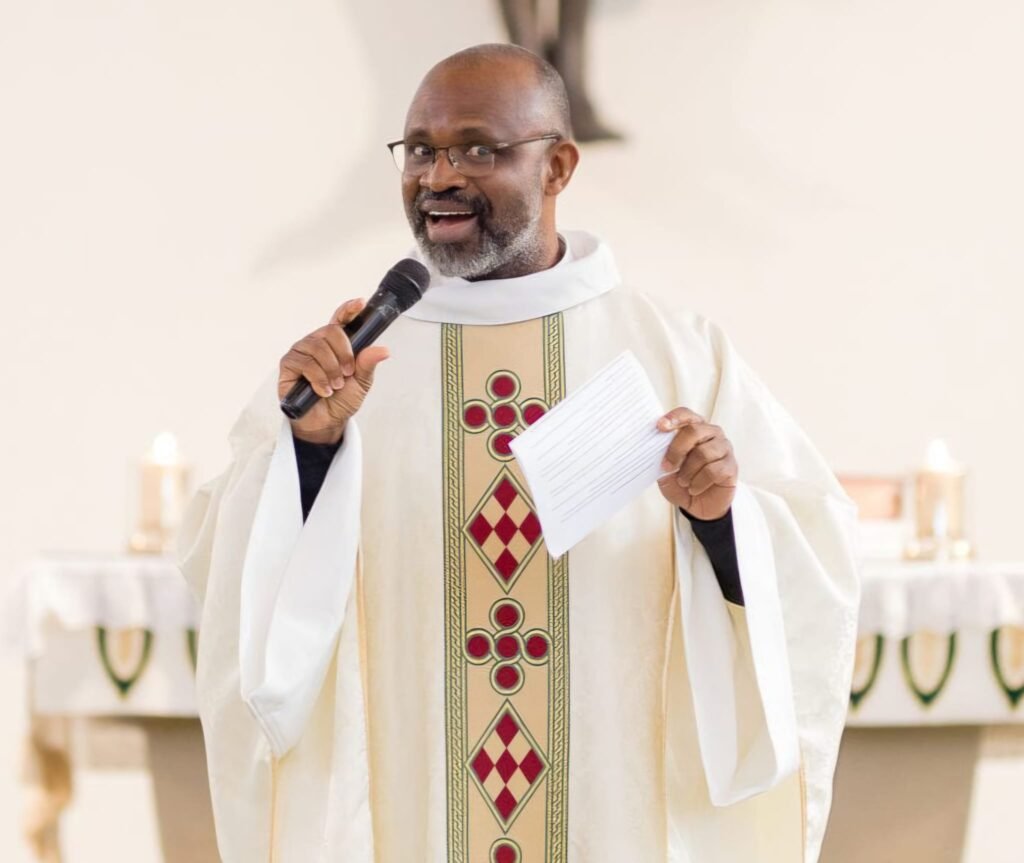
Fr. Ugochukwu Ikwuka, C.S.Sp., Provincial Superior of the Spiritan British Province.
Ezekiel 34:11–12, 15–17; 1 Corinthians 15:20–26, 28; Matthew 25:31–46.
Dear brothers and sisters,
As we come to the end of the liturgical year with the Feast of Christ the King this Sunday, the idea of a ruling monarch would probably not go down well in democracies. But kingship as a central idea in the Bible is quite a positive one. The flow of creation from God is like a majestic liturgical procession: the light first, then, the sky, the earth, the seas, the vegetation, and the animals, with human beings coming at the end as the most dignified, reflecting the priestly character of human beings who are meant to praise God on behalf of the whole of creation.
But it also reflects the royal character of human beings called in Adam to be the kings of creation; to reign on behalf of God in whose image we are made, and to govern the world according to God’s purposes of love, compassion, non-violence and justice. However, Adam’s disobedience exemplifies man’s contrary desire to govern the world according to his own purposes. And when the king goes bad, the whole nation goes bad!
At their best, leaders and kings after Adam rule according to God’s purposes. David is an example. But soon he also compromised as did successive kings after him. God’s idea to rule through his earthly agents was thus being frustrated even as the longing for the ideal king persisted, the new David who would lead as God purposed in creation, as expressed in the Prophets and the Psalms.
God’s decisive intervention came in His taking human form in the God-man Jesus, to reign as the perfect king over creation and show what God’s kingship look like as seen in the following parallels: While the kings of the earth reign from palaces, some adorned in gold, Jesus reigns in human hearts which he desires to be transformed to become golden; while the kingdoms of this world expand through conquest of rival kingdoms, his kingdom grows in our hearts through the conquest of the vices within; pride, greed, anger, selfishness, etc.
While the kings of this world exercise executive or coercive powers and are served by a retinue of aides, he is a servant-king who washes the feet of his followers. While the kings of this world receive tributes and royalties with the entire state revenue belonging to the ruling monarch in some kingdoms, Jesus came that his subjects may have life and have it to the full (John 10:10).
Hence, he is a king who rather gives and gives to the scandalous extent of totally emptying himself; hanging naked on the cross and giving up his spirit. Yet, that moment of utter degradation is in truth the most glorious moment of his reign because it is the moment when he gave the uttermost proof of his love – greater love has no man than to lay down his life for his friends (John 15:13). As he indicated, it is equally by this way of love that his followers will be known (John 13:35).
Indeed, in the end, this King will judge us only on the extent we have emptied ourselves too in loving service to him in others. As he described it in this Sunday’s Gospel, the sheep (the good guys) will be separated from the goats (the bad guys) on the basis of who fed him in the hungry, who gave him drink in the thirsty, who welcomed him in the stranger, who clothed him in the naked – the many who are stripped of their human dignity, who visited him in the sick and the imprisoned.
Yes, one does not love others just for God’s sake or to please God; one does not go to God through others, but one seeks, finds and loves God IN others. And it does not matter how they got sick; whether it be HIV-AIDS contracted through a sexually promiscuous lifestyle or through drug addiction. It does not matter why they were imprisoned; whether it be for murder or rape. It does not matter how they became strangers; whether they be legal or illegal immigrants. These people are especially to be loved because they are the most in need of having their lives turned round.
Thus, Final Judgment is about righting all the wrongs of this world. As man’s life here on earth has evolved, he has become accustomed to everything; he has adapted to every climate, become immune to every disease. But there is one thing that he has not got used to: injustice. He continues to find it intolerable. It is to this thirst for justice that the universal judgment will respond.
Today’s feast therefore calls us to live in such a way that justice is not a condemnation for us but salvation, and we can be those to whom Christ will say: “Come, blessed of my Father, take possession of the kingdom prepared for you since the foundation of the world.”
Meditation
“Yes, one does not love others just for God’s sake or to please God; one does not go to God through others, but one seeks, finds and loves God IN others.”
Originally published on SPIRITANS AFRICA AND ISLANDS on Substack.