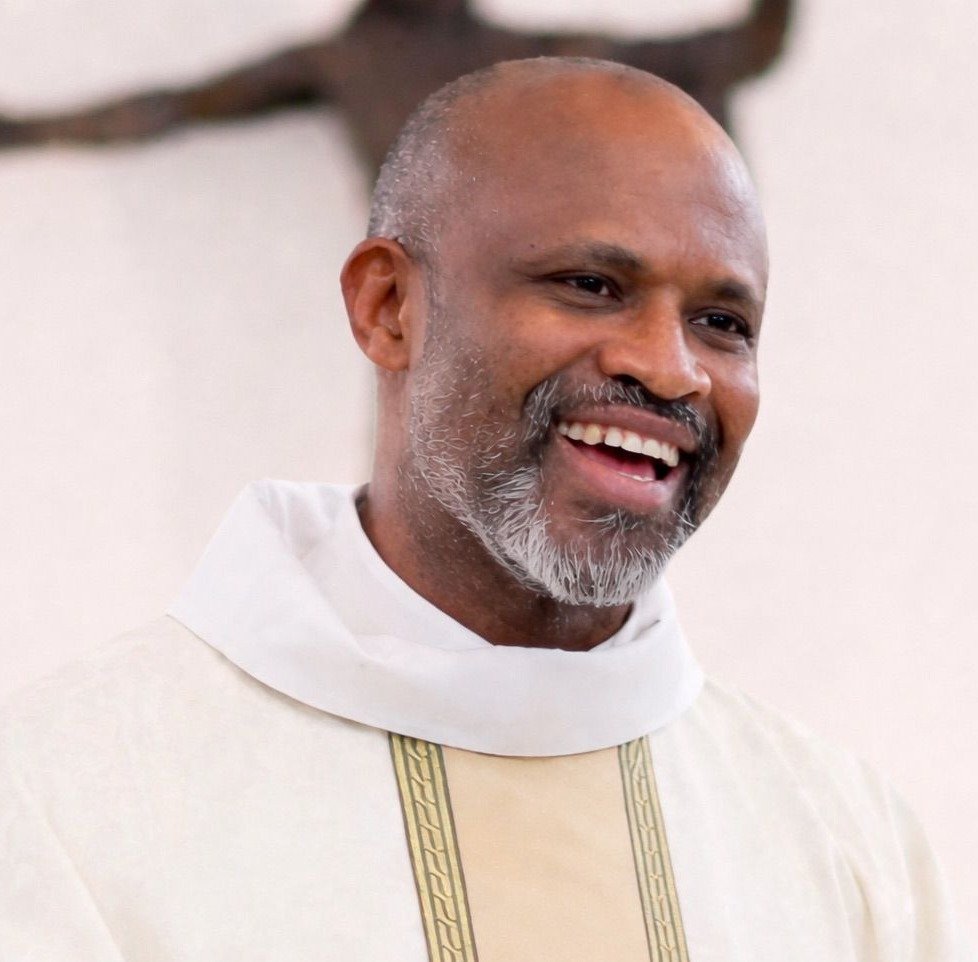
Fr. Ugochukwu Ikwuka, C.S.Sp., Provincial Superior of the Spiritan British Province.
Revelation 7:2–4, 9–14; 1 John 3:1–3; Matthew 5:1–12a.
Dear brothers and sisters,
A young boy toured Europe with his parents one summer. Part of their tour included visits to the great old cathedrals. The boy was fascinated by the massive stained glass portraits of the saints that adorned the cathedrals’ windows and how beautifully light shines through them. Upon returning home, he was asked by his Sunday school teacher about what he liked the most in the trip. For a moment he thought of those great churches and said, “I loved the sense of awe and the hugeness of who God must be, and I loved the stained glass windows with their images of the saints.” “And who is a saint?” his teacher asked. His mind went back to those beautiful windows and he said, “A saint is a person the light shines through.” How very correct!
This 1st of November, we celebrate the Feast of All Saints. Most days of the year, we celebrate the feast of individual saints. For instance, on the 4th of November, we shall celebrate the feast of St Charles Borromeo. However, the feast’s First Reading recognised “A great multitude, impossible to count, from every nation, from all tribes and peoples and languages, standing before the throne and before the Lamb, robed in white.” The majority of these saints are not accommodated in the annual liturgical calendar.
Among them would be our relatives and friends, who lived heroic lives of faith. We celebrate them today. The Book of Revelations affirms that “They will never hunger or thirst again, and the sun and scorching wind will never plague them, because the Lamb who is at the heart of the throne will be their shepherd and will guide them to the springs of living water; and God will wipe away all tears from their eyes” (Rev. 7:16, 21:4). Today’s feast can therefore be called the feast of the Unknown Saint, in line with the tradition of the Unknown Soldier.
It is quite reassuring that the saints we celebrate today were once mere mortals like us. They were not extraordinary people but people who did ordinary things extraordinarily. The human tendency is to begin to lower our guard with time; we begin to attend to everyday responsibilities complacently, as mere routines and empty rituals, without the thoroughness they deserve. The difference between us and the saints is that they never flagged in zeal – they never slacked in carrying out their ordinary everyday responsibilities.
Any time they clean or mop, they do it conscientiously; in fact they aim to do it even better at every turn. When they ask, “How are you?” they wait to hear how you really are. They don’t abridge “How are you?” to “hi” and hurry off. Like Jesus, the saints also paid a price for doing what is right. That is why the First Reading says that they are the people who went through persecution and persevered. They don’t sound politically correct so as to avoid persecution. They carried their cross and followed Jesus. That is why they share in his resurrection and eternal glory.
That path of the cross which leads to glory is the narrow path of the Beatitudes, the charter for holiness, which Jesus listed in today’s Gospel: “Happy are the poor in spirit, for theirs is the kingdom of heaven… etc.” Jesus was poor in spirit. “Although he was Almighty God, he emptied himself and took upon himself the form of a servant, and was made in the likeness of men… He humbled himself and became obedient unto death, even the death of the cross” (Phil. 2:5-8).
Often, we think of the poor in spirit as the downtrodden. But the true meaning is humility of heart. Mother Teresa was apt in noting that “Humility is the mother of all virtues. It is in being humble that our love becomes real, devoted and ardent. If you are humble nothing will touch you, neither praise nor disgrace, because you know what you are. If you are blamed you will not be discouraged. If they call you a saint you will not put yourself on a pedestal.”
We can measure our lack of humility by our hunger for the praise of others, our desire for position, our eagerness for recognition, our good opinion of ourselves and our habit of contrasting our own ability, efforts, or accomplishments with those of others. We can measure our lack of humility by how often we feel hurt and slighted, how deeply we feel resentment, how discouraged we become from the criticism of others, how much we grumble about how we are treated, how critical we are of others, and how much we gossip about others.
When he was asked, “What is the most difficult instrument to play?” The famous orchestra conductor Leonard Bernstein responds: “Second fiddle – I can get plenty of first violinists, but to find one who plays second violin with enthusiasm… that’s a problem. And if no one plays second, we have no harmony.” That’s the way of the world. But how radical Jesus’ wisdom is! How opposed to conventional wisdom! That’s why St Paul declared that: “The message of the cross is foolishness to those who are perishing, but to those who are being saved it is the power of God….” (1 Cor. 1:18).
The Christian Hall of Fame is full of people who were first humbled, and then used for God’s glory. As the English statesman William Wilberforce submitted, “It might be said that the great aim and purpose of all revelation, and especially the design of the Gospel, is to reclaim us from our natural pride and selfishness with their fatal consequences.”
Meditation
“It is quite reassuring that the saints we celebrate today were once mere mortals like us. They were not extraordinary people but people who did ordinary things extraordinarily.”
Originally published on SPIRITANS AFRICA AND ISLANDS on Substack.